


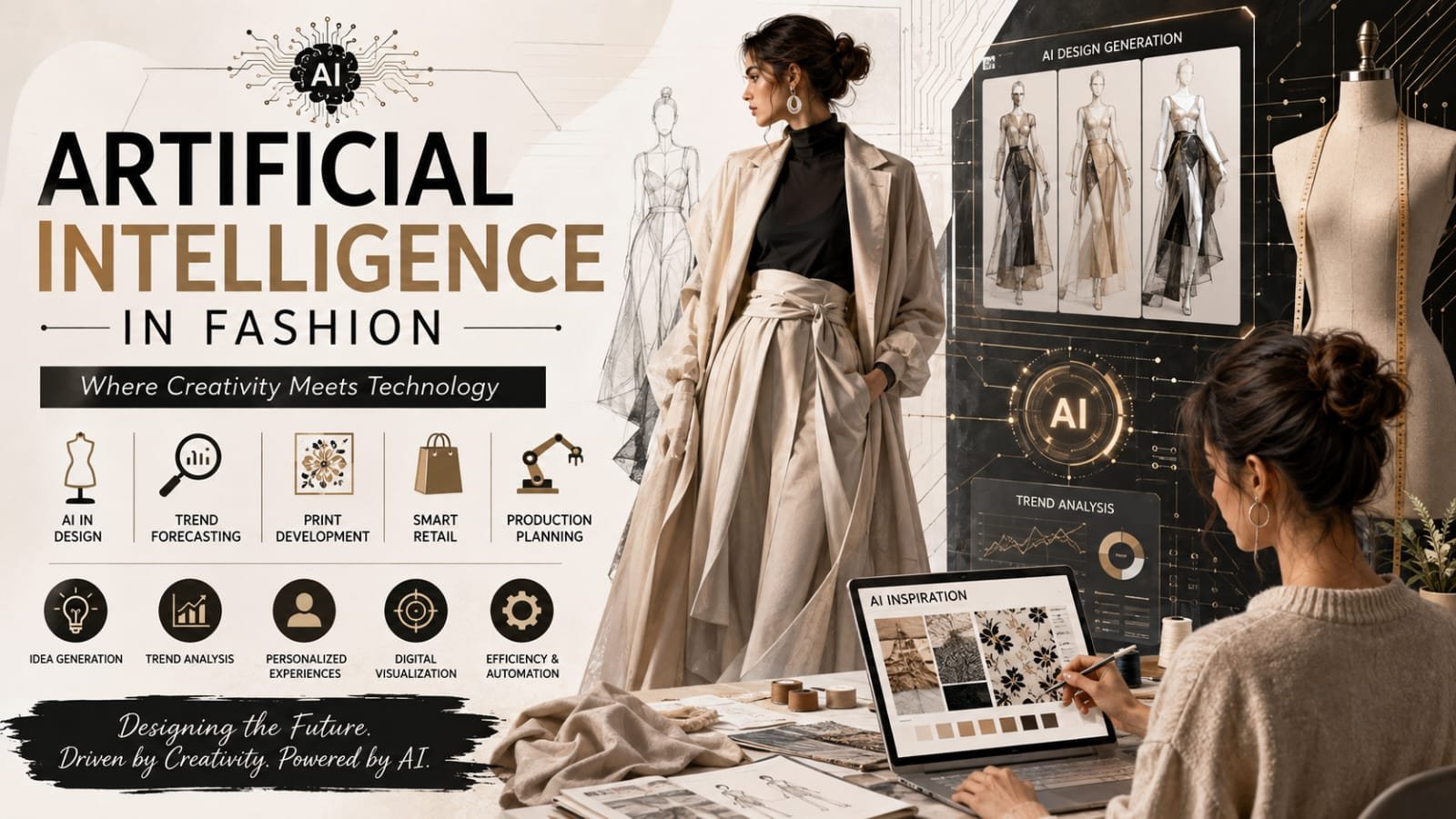
Artificial Intelligence In Fashion
ARTIFICIAL INTELLIGENCE IN FASHION
Where Creativity Meets Technology
Technology has always influenced fashion, from sewing machines and digital pattern-making to e-commerce and virtual fashion shows. Today, Artificial Intelligence (AI) is becoming another important technology in the fashion industry.
AI can assist designers, brands, manufacturers, retailers, and consumers in different stages of the fashion process. It can help generate ideas, analyse trends, predict demand, personalize shopping experiences, and improve efficiency.
AI in Fashion Design
One of the most interesting applications of AI is in the design process. Designers can use AI-based tools to explore different silhouettes, colours , prints, textures, garment details, and styling concepts.
For example, a designer can develop a basic concept and use digital tools to visualize multiple variations. This can help during the early stages of design development.
AI can also be used to create mood-board concepts and visual references, allowing designers to explore different creative directions before developing the final design.
AI for Trend Forecasting
Fashion trends change rapidly. Understanding what consumers may want in the future is an important part of fashion business.
AI can analyse large amounts of information, such as online searches, social media activity, customer behaviour, and previous sales data. This information can help fashion companies identify patterns and understand emerging trends.
However, trend prediction still requires human interpretation because fashion is strongly influenced by culture, emotions, events, and social behaviour.
AI and Print Development
AI can support print and surface-pattern development by generating variations of motifs, compositions, colour combinations, and repeat patterns.
A designer can begin with an inspiration such as nature, architecture, traditional art, or geometric forms and explore multiple digital interpretations.
The designer then selects, modifies, and develops the final artwork according to the design concept.
AI in Fashion Retail
AI is also changing the shopping experience. Online fashion platforms can use AI to recommend products based on a customer's browsing and purchasing behaviour.
Virtual try-on technologies can allow customers to visualize how certain garments or accessories may look before making a purchase.
This can make online shopping more personalized and interactive.
AI and Fashion Production
AI can help fashion companies improve production planning and inventory management. By analysing sales and demand patterns, companies can make better decisions about how much stock to produce.
Better demand forecasting can potentially reduce overproduction and unnecessary inventory.
Benefits of AI in Fashion
AI can provide several advantages:
- Faster idea generation
- Support for design experimentation
- Trend and demand analysis
- Personalized shopping experiences
- Improved production planning
- Digital visualization
- Assistance in repetitive tasks
Challenges of AI in Fashion
Despite its advantages, AI also creates challenges. One major concern is the question of originality and ownership of AI-generated content. Designers must understand copyright and intellectual-property considerations when using AI tools.
Another concern is that excessive dependence on AI may reduce experimentation and personal creative thinking. AI should therefore be treated as a supporting tool rather than a replacement for the designer.
The Future of AI and Fashion
The future of fashion will likely involve stronger collaboration between designers and technology. AI can handle large amounts of information and generate possibilities, while human designers provide emotion, cultural understanding, creativity, judgement, and a clear design vision.
Conclusion
Artificial Intelligence is transforming the fashion industry, but technology alone cannot create meaningful fashion. The strongest results come when human creativity and technological capabilities work together. AI can help designers explore more possibilities, while the designer remains responsible for the final creative direction.